Through Prime E-Sport Lounge Group of Companies and related equipment-rental activity, I learned that an asset is not profitable merely because customers like it or because the advertised rental price looks high. A trampoline, game system, party item or other rental asset must recover its purchase cost, transport, setup, maintenance, cleaning, staff time, downtime and damage risk. The owner also has to distinguish what the equipment could earn at full use from what it actually earns at current utilization.
Potential revenue is not actual return
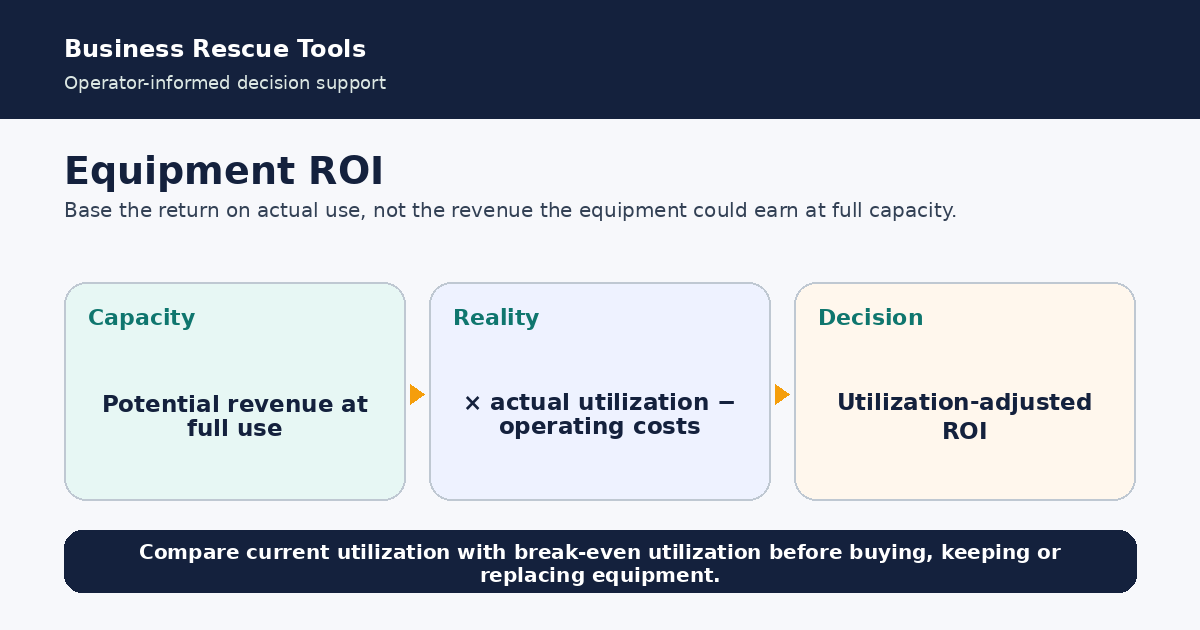
The most common mistake is to multiply the rental price by an optimistic number of bookings and call the result ROI. That calculation ignores idle days and operating cost. The revised Equipment ROI Calculator starts with full-capacity revenue, applies actual utilization, subtracts operating costs and then compares the resulting profit with the capital invested. If utilization changes, the ROI changes. That is the behavior an owner needs to see before buying more equipment.
Payback depends on contribution per booking
Revenue per booking is not the amount available to recover the asset. Transport, setup, fuel, labor, cleaning, repairs, consumables and platform fees reduce the contribution from each booking. The payback period should therefore use net contribution, not gross revenue. A high-priced booking can still have a weak payback if delivery is expensive or the asset requires frequent repair.
Idle equipment has a real cost
An unused asset ties up capital that could fund inventory, payroll or another service. It may also lose value, require storage and become obsolete. The decision is not automatically to sell it; an owner may improve marketing, bundle it with a stronger product, adjust the rate, reduce transport waste or target a different event type. The key is to compare current utilization with break-even utilization and set a time-limited improvement target.
Deposits protect more than the booking
Equipment rentals create exposure before the event: the date is reserved, transport may be arranged and another customer may be turned away. A deposit should reflect the costs and opportunity that become committed before final payment. Damage deposits, customer balances and cancellation terms should be tracked separately so revenue is not confused with refundable obligations.
How the field experience shaped the tools
The equipment calculators connect purchase cost, utilization, contribution, payback and idle cost because these decisions are inseparable in a small operation. The goal is not to produce a flattering percentage. It is to answer a practical question: should the owner buy, retain, reprice, promote, repair, replace or release the asset?
Use the connected calculators
- Equipment ROI Calculator
- Equipment Payback Calculator
- Equipment Utilization Calculator
- Idle Equipment Cost Calculator
McCauley, Jackie. “What Equipment Rental Operations Taught Me About Payback, Utilization and Hidden Cost.” Business Rescue Tools Operator Field Notes, August 5, 2026.