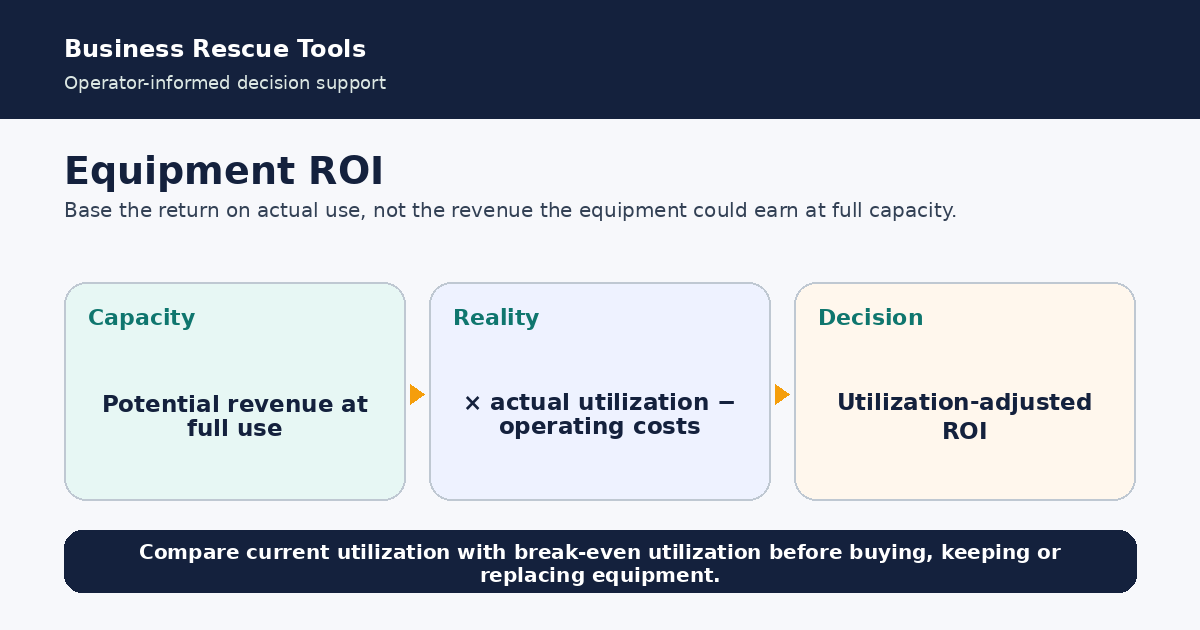
What this calculator answers
Is the equipment generating an acceptable return on the cash invested?
Formula and assumptions
The result is an estimate. It is only as reliable as the inputs, and it does not account for every tax, legal, financing or operational consequence.
Worked example
Example: Equipment costs $10,000. Full practical monthly revenue capacity is $1,800. At 65% utilization, estimated monthly revenue is $1,170. After $500 of monthly operating cost, net operating cash contribution is $670 per month, or $8,040 per year. Annual operating cash ROI is therefore 80.4% ($8,040 ÷ $10,000), and simple payback is about 1.2 years. If the equipment is held for 5 years and then sold for an estimated $2,000, the planning-model holding-period total return is 322.0%. Operating-cost break-even occurs at approximately 27.8% utilization.
How to interpret the result
- Low: no immediate gap or the entered position is comparatively protected.
- Medium: manageable pressure exists, but it should receive a dated correction plan.
- High: the problem can materially damage cash or operations and requires near-term action.
- Critical: the entered assumptions indicate immediate loss, shortage or survival risk.
Authoritative references
- IFRS Foundation: IAS 16 Property, Plant and Equipment
- IFRS Foundation: IAS 36 Impairment of Assets
- FASB: Standards and Accounting Standards Codification
These references explain relevant accounting, cash-flow, legal or control concepts. Business Rescue Tools remains responsible for the calculator formula, assumptions and editorial thresholds.
Do not approve equipment from one optimistic ROI number
The calculator now shows a downside, base and upside utilization case. This matters because equipment can look profitable at planned demand while failing to cover operating cash cost if bookings or production volume arrive below plan.
For a material capital purchase, collect the vendor quote, financing terms, maintenance plan, expected downtime, useful-life assumption and realistic utilization evidence. This tool deliberately keeps tax depreciation, impairment, NPV/IRR and financing conclusions separate.
Frequently asked questions
How is annual equipment ROI calculated?
Annual operating cash ROI = annual net operating cash contribution ÷ initial purchase and setup cash invested. Revenue is first adjusted for realistic utilization and monthly operating cost is deducted.
Why is resale value not subtracted from the investment denominator?
Resale proceeds are expected in the future, not available on the purchase date. This model therefore keeps the full initial cash investment in annual operating ROI and treats expected resale separately in the holding-period return.
What does 100% practical utilization mean?
It is realistic revenue capacity after normal operating hours, setup time, maintenance and expected downtime—not an impossible 24-hour maximum.
What is the holding-period return?
It combines cumulative net operating cash contribution over the entered holding period with the expected resale proceeds, less the initial cash invested. It is a planning return, not an appraisal or tax calculation.
Does this include depreciation, financing or tax deductions?
No. Accounting depreciation, impairment, lease treatment, tax deductions and financing cash flows require separate analysis.
Should I buy equipment if the ROI is positive?
Not automatically. Stress-test utilization, downtime, maintenance, financing cost, useful life and alternative uses of the cash before committing to the purchase.
Why does the calculator show a 20% lower-utilization scenario?
Equipment demand is rarely exact. The downside case tests whether the asset still generates operating cash if actual utilization is 20% below the entered base case.
Should I compare ROI with the financing payment?
Yes. The operating-cash return should be compared with debt service and financing cost before a financed purchase is approved. This calculator does not treat financing as part of the operating ROI formula.