Business Cash Shortfall Calculator

How much cash is missing to cover essential obligations and a minimum safety reserve?

Calculate your result

Use figures from the same period and currency. Avoid mixing estimates with verified amounts without noting the difference.

The formula is currency-neutral; keep all monetary inputs in the same currency.
Cash in bank, till and immediately available wallets.
Only include payments you reasonably expect during this period.
Rent, payroll, utilities, inventory and critical operating costs.
Amounts that must be paid during the same period.
Cash you do not want the business to fall below.
Name or role for the printed management record.
Date assigned for the next review or corrective action.

Privacy: This calculation runs in your browser. The figures you enter are not submitted to our server.

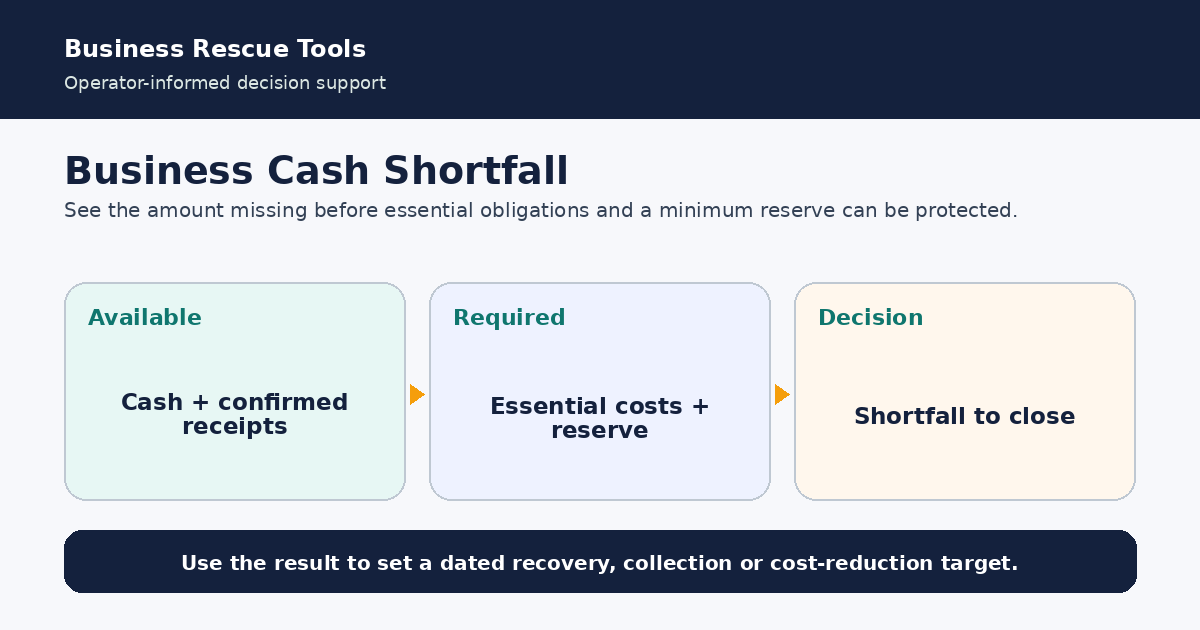
See the gap between available cash and essential obligations.
Decision diagram: See the gap between available cash and essential obligations.

Why this matters

A cash shortfall is not the same as an accounting loss. A business can show sales or profit on paper and still be unable to pay payroll, suppliers, rent or debt when cash is due. This calculator focuses management on whether confirmed cash resources cover essential obligations and the minimum reserve needed to keep operating. The answer is useful because it turns a general cash concern into a quantified decision with a time window, owner and next step.

Use current bank and cash balances, receipts that are genuinely confirmed, a dated list of essential operating costs, debt due dates and the minimum reserve management refuses to spend. Keep every figure in the same currency and planning period. Separate confirmed cash from hoped-for sales, and label estimates so they are not mistaken for verified balances. Cash-flow guidance should be read as an operating forecast, not a statement of profit. The central discipline is timing: cash must be available before an obligation becomes due.

How to act on the result

  1. Separate essential payments from costs that can be delayed without damaging the business
  2. Contact customers and lenders before the due date rather than after a missed payment
  3. Build a dated 13-week cash plan and assign an owner to every inflow and outflow

Stress-test the result by changing the most uncertain input. A responsible decision should survive a slower collection case, a cost overrun or a delayed receipt. Recalculate when new evidence arrives instead of allowing an old output to become a permanent forecast.

Common mistakes and limits

Watch for counting hoped-for sales as confirmed cash, omitting taxes or debt arrears, and using the same reserve money to cover several obligations. This calculator does not prepare a GAAP or IFRS cash-flow statement, predict insolvency or establish that financing is affordable. It is a management diagnostic built from the figures entered. If the calculated gap cannot be closed without missing payroll, taxes, secured debt or critical supplier payments, obtain qualified accounting or restructuring advice promptly.

What this calculator answers

How much cash is missing to cover essential obligations and a minimum safety reserve?

Formula and assumptions

Shortfall = Essential obligations + safety reserve − available cash − confirmed incoming cash.

The result is an estimate. It is only as reliable as the inputs, and it does not account for every tax, legal, financing or operational consequence.

Worked example

Example: A business has $5,000 in available cash and $1,000 in receipts that are confirmed for the period. Essential costs are $4,200, debt payments are $1,800, and the owner wants to preserve a $1,000 operating reserve. Total required cash is $7,000. Available resources are $6,000. The projected shortfall is therefore $1,000, or 14.3% of the requirement.

How to interpret the result

  • Low: no immediate gap or the entered position is comparatively protected.
  • Medium: manageable pressure exists, but it should receive a dated correction plan.
  • High: the problem can materially damage cash or operations and requires near-term action.
  • Critical: the entered assumptions indicate immediate loss, shortage or survival risk.

Authoritative references

These references explain relevant accounting, cash-flow, legal or control concepts. Business Rescue Tools remains responsible for the calculator formula, assumptions and editorial thresholds.

Frequently asked questions

What counts as a confirmed inflow?

Use only an amount with a credible payer, amount and expected receipt date. A sales hope, unsigned promise or unapproved loan should not be entered as confirmed.

Should I include a cash reserve in the requirement?

Yes, when the reserve is genuinely needed to keep the business operating after the immediate obligations are paid. A zero reserve can make a fragile position look safer than it is.

What if the shortfall is temporary?

Separate a timing gap from a structural loss. A timing gap has dated inflows that can realistically close it; a structural loss continues because normal revenue does not cover normal costs.

Does a zero shortfall mean the business is healthy?

No. It only means the entered resources cover the entered obligations and reserve for this period. Profitability, debt sustainability and future cash needs require separate analysis.