Prime Money Services, Jackie’s Nursery & Floral, Prime E-Sport Lounge Group of Companies and digital-product work do not share the same cash cycle. One business may need float available throughout the day, another buys materials before delivery, another earns through bookings and equipment use, and another receives income after a digital sale. Managing across those models taught me that “we need more money” is not a diagnosis.
First separate a shortfall from a timing gap
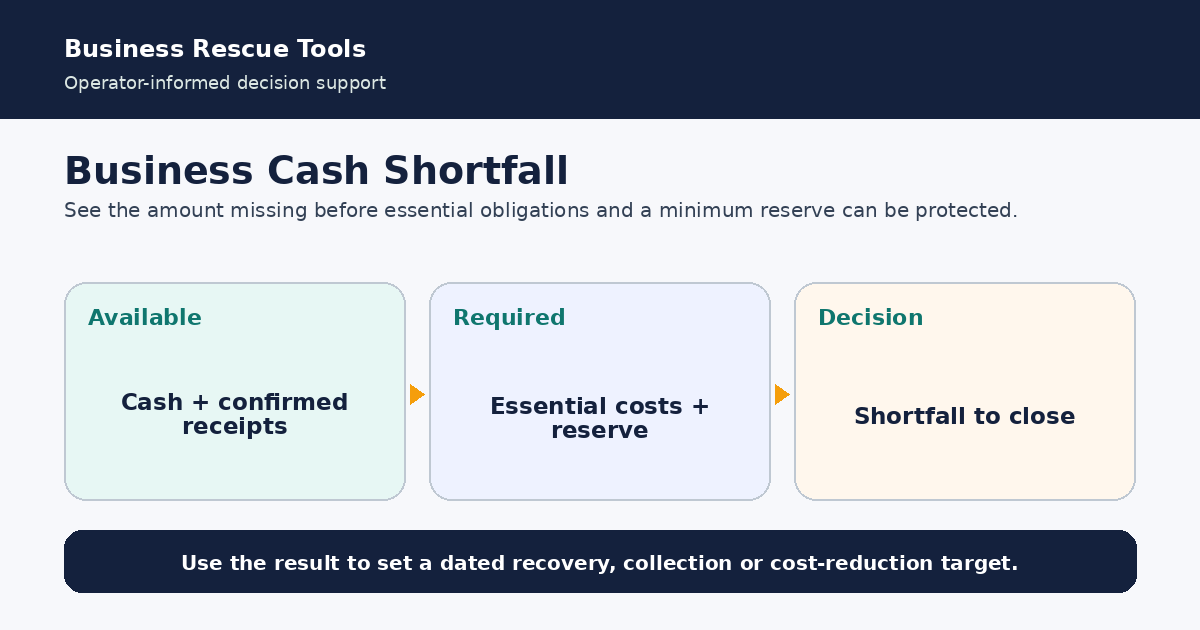
A business can be profitable on paper and still lack the cash required this week. Confirmed receipts may arrive after payroll, inventory or transport is due. The Business Cash Shortfall Calculator therefore compares cash and confirmed near-term receipts with essential obligations and a minimum reserve. It does not treat uncertain sales as available cash.
Then identify the cause
A shortfall can come from overdue customer balances, weak margins, excessive fixed costs, debt pressure, idle assets, staff exposure or owner withdrawals. Those causes require different actions. Chasing more sales will not rescue a business that loses money on each sale. Cutting marketing will not solve a reconciliation problem. The Business Rescue Priority Score is an editorial framework for deciding which pressure receives attention first.
Protect a minimum operating reserve
Using every available dollar to settle today’s bills can leave the business unable to open tomorrow. The appropriate reserve varies, but the owner should make it explicit. The calculator includes a reserve target so the result does not falsely show safety after essential cash has been exhausted.
Use dated actions rather than vague intentions
A useful rescue result should lead to one measurable action: collect a defined amount by a date, delay a nonessential expense, adjust a price, secure a deposit, sell or promote an idle asset, reconcile a shortage or negotiate a payment schedule. The business should recalculate after the action to confirm that the gap actually improved.
How administrative experience shaped the approach
More than twenty years in customer service, human resources, office administration and client liaison reinforced the importance of records, assigned responsibility, deadlines and follow-through. A number without an owner and a due date is not a control. The cash-flow tools therefore pair the calculation with an action and revision note.
Separate restricted and available money
Another lesson is that not every balance on hand is available for rescue. Customer deposits may be committed to a specific order, refundable amounts may belong to customers, and settlement funds may need to remain available for transaction obligations. A cash-shortfall analysis should exclude money that cannot legally or operationally be redirected. Treating restricted value as free cash can hide the real gap until the obligation falls due.
Review the rescue plan after the next close
A plan should not remain open-ended. After the collection, price change, cost reduction or reconciliation action, the owner should run the calculation again using verified balances. If the shortfall remains, the problem was either larger than expected or the chosen action did not address the main cause. That feedback loop is what turns a calculator from a one-time estimate into a basic management control.
Use the connected calculators
- Business Cash Shortfall Calculator
- Business Rescue Priority Score
- Cash Runway Calculator
- Payroll Coverage Calculator
McCauley, Jackie. “What Managing Different Small Businesses Taught Me About Cash Shortfalls and Rescue Priorities.” Business Rescue Tools Operator Field Notes, August 5, 2026.