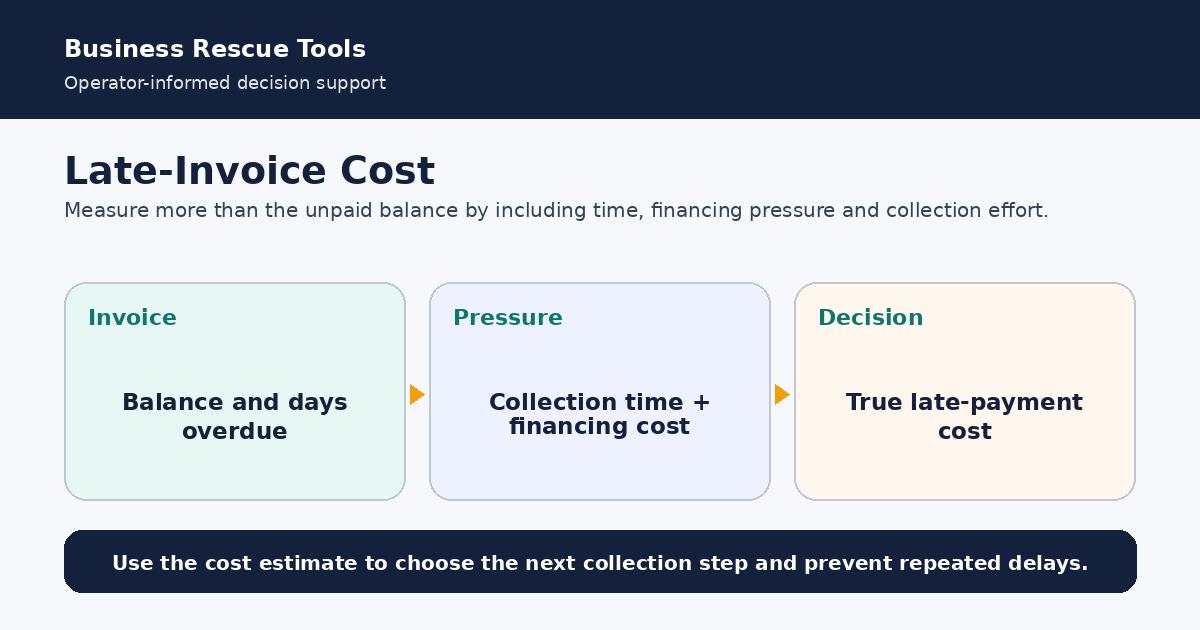
What this calculator answers
What is an overdue invoice really costing the business?
Formula and assumptions
The result is an estimate. It is only as reliable as the inputs, and it does not account for every tax, legal, financing or operational consequence.
Worked example
Example: A $3,000 invoice is 45 days overdue. Using an 18% annual financing or opportunity-cost rate, the delayed-cash cost is $66.58. Three hours of collection work at $20 per hour adds $60, and the owner enters $100 of lost contribution. The estimated cost of the delay is therefore $226.58. If normal monthly revenue is $10,000, the unpaid invoice also equals 30% of one month’s revenue.
How to interpret the result
- Low: no immediate gap or the entered position is comparatively protected.
- Medium: manageable pressure exists, but it should receive a dated correction plan.
- High: the problem can materially damage cash or operations and requires near-term action.
- Critical: the entered assumptions indicate immediate loss, shortage or survival risk.
Authoritative references
- IFRS Foundation: IFRS 9 Financial Instruments
- IFRS Foundation: IFRS 15 Revenue from Contracts with Customers
- FASB: Standards and Accounting Standards Codification
These references explain relevant accounting, cash-flow, legal or control concepts. Business Rescue Tools remains responsible for the calculator formula, assumptions and editorial thresholds.
Two different questions: your cost of waiting vs. a fee charged to the customer
Cost of waiting estimates the economic damage to your business: financing/opportunity cost, collection time and lost contribution. A late fee is different. It is an amount you may charge only if the contract and applicable law allow it.
The calculator keeps these two numbers separate so an internal business cost is never presented as an amount the customer automatically owes.
Frequently asked questions
What is an overdue invoice costing my business?
The calculator combines the financing or opportunity cost of delayed cash, staff or owner collection time, and any separately estimated contribution lost because the cash was unavailable.
Is the annual rate the late fee I can charge?
No. It estimates your own financing or opportunity cost. A chargeable late fee depends on the contract and applicable law.
How should I calculate a late fee on an invoice?
First check the signed payment terms and the law that applies to the transaction. Do not assume that your internal cost-of-cash rate is a fee you can charge the customer.
From which date should I count overdue days?
Use the contractual due date. If the agreement does not state one, verify the commercial terms and applicable local requirements before treating the invoice as overdue.
Should collection time be included?
Yes for internal management analysis. Owner or staff time spent chasing, reconciling and documenting payment has an economic cost even when it is not recoverable from the customer.
Can I count both financing cost and lost contribution?
Only if they describe different effects and you are not double-counting the same loss. Keep the lost-contribution input conservative and documented.
How do I calculate a late fee on an overdue invoice?
If your written terms and applicable law permit it, choose the fee method, enter the agreed rate or flat amount, and subtract any grace period from overdue days. The result shows the illustration separately from the economic cost to your business.
Is the late-fee estimate legal advice?
No. Contract terms, notice requirements, interest caps and enforceability vary by jurisdiction. The calculator illustrates arithmetic only and does not create a right to charge a fee.