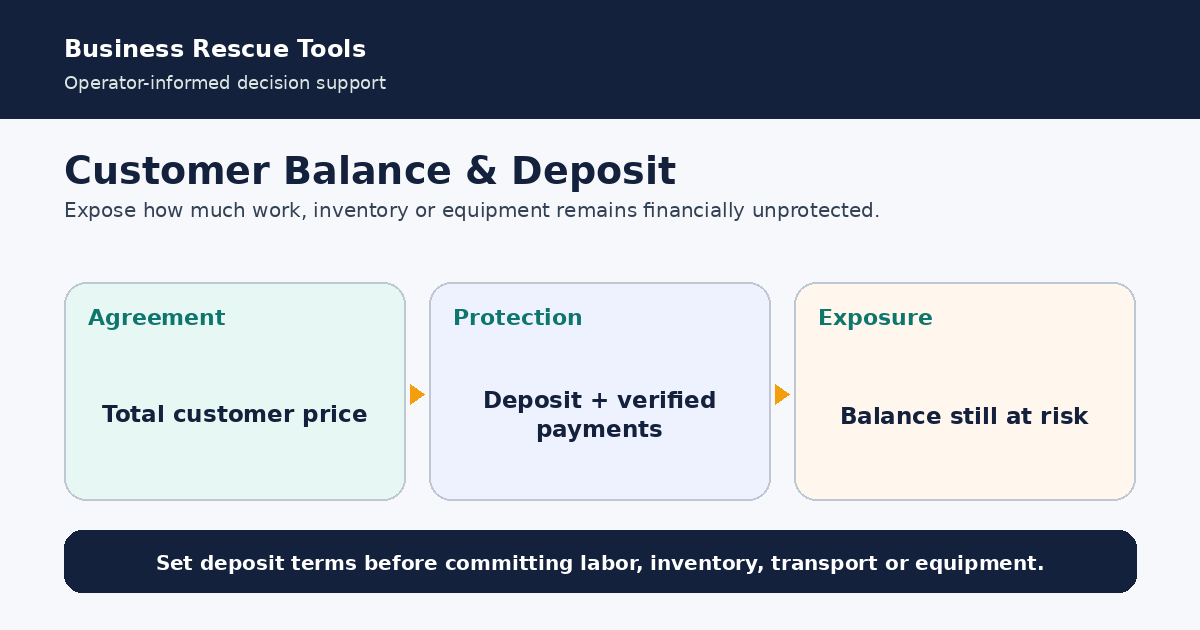
Managing Jackie’s Nursery & Floral, event-related services and other owner-led businesses showed me that a customer balance becomes risky before an invoice is technically overdue. The risk begins when the business commits flowers, materials, equipment, transport, labor or a date while the customer has paid too little to protect that commitment. A deposit is therefore a control tool, not just a sign of goodwill.
A deposit should match the exposure created
A flat deposit percentage can be convenient, but it may not cover the real cost at risk. A custom floral order may require materials that cannot be reused. An equipment booking may block the date for another customer. A service job may require transport or staff before final payment. The minimum deposit should at least cover nonrecoverable commitments and provide a buffer for cancellation or delayed settlement.
Customer money needs separate labels
Owners often remember the total received but lose track of what the payment represents. A deposit, progress payment, refundable damage deposit and final balance are not the same. They should be recorded separately with the agreed price, due date, payment method and remaining obligation. This prevents a refundable amount from being treated as earned revenue and makes follow-up messages specific rather than vague.
Balance tracking protects customer relationships
Clear records make communication less confrontational. Instead of arguing about what remains, the business can state the original price, payments received, outstanding balance and deadline. That is especially important where customers pay in installments or through different channels. The Customer Balance and Deposit Calculator was designed to expose the unprotected amount before the business commits further value.
Late payment has operational cost
The damage from a late balance includes more than financing cost. It can delay supplier payment, reduce available inventory, consume collection time and force the owner to use money reserved for another job. The Late-Invoice Cost Calculator makes those consequences visible so the next action can be proportional to the damage rather than driven by frustration alone.
How the field experience shaped the tools
The customer-payment tools move from prevention to recovery: set a protective deposit, track every payment, calculate the exposed balance, measure the cost of delay and prioritize collection. That sequence reflects how owner-managed businesses actually experience the problem.
Connect the balance to a specific deadline and delivery stage
A balance becomes easier to manage when it is tied to the next business commitment. Instead of recording only “customer owes $X,” the owner should note what happens next: materials are purchased, equipment is dispatched, a date becomes nonrefundable or final delivery is released. That connection allows the business to pause further exposure when the payment condition has not been met.
Use one written record across payment channels
Customers may pay by cash, mobile money, bank transfer or another person. The payment channel should not create separate versions of the truth. Every receipt should be posted to one customer record with the date, amount, reference and remaining balance. This also makes later follow-up more accurate and reduces disputes caused by memory or screenshots stored on different phones.
Use the connected calculators
- Customer Balance and Deposit Calculator
- Minimum Customer Deposit Calculator
- Late-Invoice Cost Calculator
- Collection Priority Calculator
McCauley, Jackie. “What Running Floral, Event and Service Businesses Taught Me About Customer Deposits and Balances.” Business Rescue Tools Operator Field Notes, August 5, 2026.