Calculate your result
Use figures from the same period and currency. Avoid mixing estimates with verified amounts without noting the difference.
Privacy: This calculation runs in your browser. The figures you enter are not submitted to our server.
Why this matters
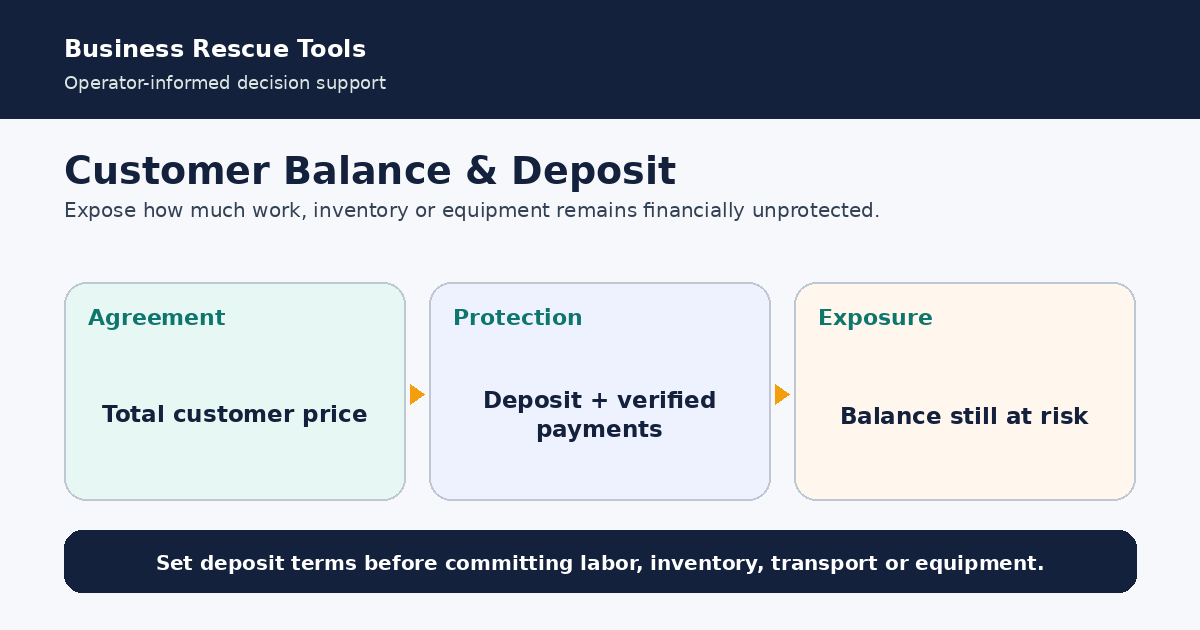
A deposit should protect the business from cash it must commit before final payment. A round percentage chosen by habit may be too small for materials, labor, cancellations and change risk. The calculation helps decide the unpaid customer balance and whether the deposit covers upfront direct costs plus a deliberate cost contingency buffer. That distinction matters because a balance can appear as revenue or a receivable while the business still lacks spendable cash.
Use the agreed contract price, every payment received, supplier and labor costs incurred before delivery, and a documented risk buffer based on cancellation or customization exposure. Reconcile the figure to the customer contract, invoices, credits and payments before relying on the result. Receivable guidance separates earned or billed revenue from cash actually collected. Contract terms, disputes, collectibility and local recovery law remain decisive. A calculator cannot determine whether an amount is legally due, collectible or properly recognized in the accounts.
How to act on the result
- Set the deposit before work starts and show the balance schedule in the customer agreement
- Separate refundable and non-refundable amounts clearly
- Pause additional work when the customer balance exceeds the approved exposure limit
Use the output to create a dated collection or deposit decision. Record who will contact the customer, what evidence will be sent, what payment method is available and what happens if the commitment is missed. The strongest process removes ambiguity and applies the same escalation logic consistently.
Common mistakes and limits
Avoid treating a deposit as revenue before performance, failing to record refunds or change orders, and accepting a deposit that does not cover nonrecoverable commitments. The output is not a credit score, legal demand or expected-credit-loss calculation under IFRS 9 or U.S. GAAP. Those conclusions can require forward-looking data, accounting policy and professional judgment. For complex contracts, consumer deposits or long delivery periods, confirm revenue recognition, refund duties and trust-account requirements with a qualified professional.
What this calculator answers
What balance remains, and did the deposit cover committed direct costs?
Formula and assumptions
Customer balance = total price − deposit − later payments. Cost-covering deposit target = upfront direct costs × (1 + risk buffer %).
The result is an estimate. It is only as reliable as the inputs, and it does not account for every tax, legal, financing or operational consequence.
Worked example
Example: A customer order totals $1,500. The customer paid a $300 deposit and another $200 later, leaving a $1,000 balance. The business must commit $550 of upfront cost and selects a 10% risk buffer, producing a cost-covering deposit target of $605. The deposit is therefore $305 below the protection target.
How to interpret the result
- Low: no immediate gap or the entered position is comparatively protected.
- Medium: manageable pressure exists, but it should receive a dated correction plan.
- High: the problem can materially damage cash or operations and requires near-term action.
- Critical: the entered assumptions indicate immediate loss, shortage or survival risk.
Authoritative references
These references explain relevant accounting, cash-flow, legal or control concepts. Business Rescue Tools remains responsible for the calculator formula, assumptions and editorial thresholds.
Frequently asked questions
How large should a customer deposit be?
A practical starting point is enough to cover non-refundable upfront exposure plus a reasonable risk buffer, while remaining consistent with the contract and local consumer law.
Can a deposit always be described as non-refundable?
No. Whether a deposit may be retained depends on the agreement, actual loss and applicable law. Avoid terms that impose a disproportionate penalty.
Why does the calculator block overpayments?
Deposit plus later payments should not exceed the stated order price without a documented credit, change order or refund. The validation prevents an accidental contradiction.
Should customer deposits be treated as profit immediately?
Not necessarily. Accounting and tax treatment varies, and the business may still owe goods, services or a refund obligation. Keep deposit records separate and clear.