Calculate your result
Use figures from the same period and currency. Avoid mixing estimates with verified amounts without noting the difference.
Privacy: This calculation runs in your browser. The figures you enter are not submitted to our server.
Why this matters
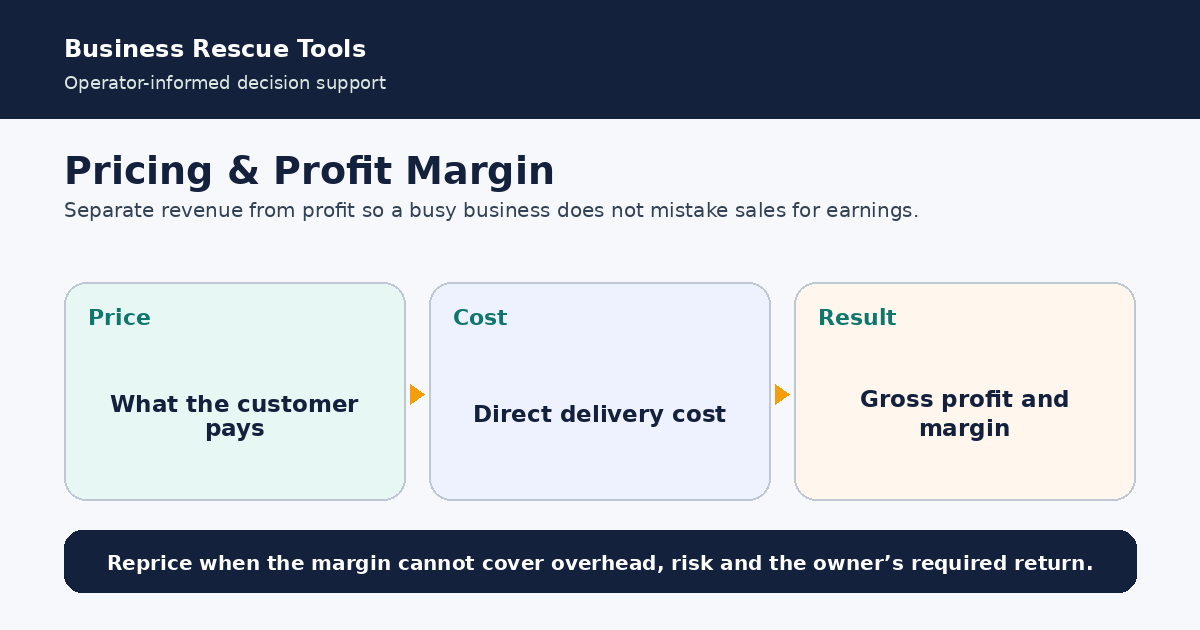
Revenue can grow while profit disappears. A price that covers variable cost may still fail after fixed overhead, discounts, rework and low volume are included. This calculator supports the decision about the contribution per sale, operating profit at the entered volume and the operating margin compared with the target. It is designed to expose the economic relationship among price, cost, volume and contribution before management relies on revenue growth alone.
Use actual selling price, unit-level variable costs, realistic sales volume, period fixed costs and a target margin supported by risk and reinvestment needs. Keep cost definitions consistent: a variable cost should change with the unit or job, while fixed costs belong to the selected period. Pricing guidance uses contribution and managerial-accounting relationships. GAAP and IFRS do not prescribe a selling price or a universal break-even threshold. Financial-reporting standards govern recognition and presentation; they do not guarantee that a quoted price is commercially sustainable.
How to act on the result
- Correct missing costs before changing the price
- Test a price, volume and cost scenario together because each can change customer demand and capacity
- Review actual margin after discounts, refunds and waste rather than relying on list price
Run at least three scenarios: current conditions, a realistic improvement and a downside case. Check whether the required volume fits practical capacity and whether the market will accept the price. The goal is not to produce a perfect percentage; it is to make the trade-off visible before a discount, quote or expansion commits cash.
Common mistakes and limits
Watch for confusing markup with margin, allocating overhead inconsistently, ignoring owner labor and using sales volume that exceeds practical capacity. Results exclude taxes, financing structure and complex cost behavior unless the inputs expressly include them. They are managerial estimates, not audited profit measures or GAAP/IFRS accounting policies. Persistent negative margin requires a product, customer or operating-model decision; small price edits cannot rescue an offer that destroys value at every sale.
What this calculator answers
Is the current selling price producing enough real profit?
Formula and assumptions
Unit contribution = price − variable cost; operating profit = contribution × units − fixed costs; margin = profit ÷ revenue.
The result is an estimate. It is only as reliable as the inputs, and it does not account for every tax, legal, financing or operational consequence.
Worked example
Example: A product sells for $100 and has $55 of variable cost. At 100 sales, revenue is $10,000 and variable cost is $5,500, leaving $4,500 of contribution. After $2,500 of fixed cost, estimated operating profit is $2,000, equal to a 20% operating margin.
How to interpret the result
- Low: no immediate gap or the entered position is comparatively protected.
- Medium: manageable pressure exists, but it should receive a dated correction plan.
- High: the problem can materially damage cash or operations and requires near-term action.
- Critical: the entered assumptions indicate immediate loss, shortage or survival risk.
Authoritative references
These references explain relevant accounting, cash-flow, legal or control concepts. Business Rescue Tools remains responsible for the calculator formula, assumptions and editorial thresholds.
Frequently asked questions
What is the difference between margin and markup?
Margin measures profit as a percentage of selling price. Markup measures the amount added to cost as a percentage of cost. They are not interchangeable.
Which costs belong in variable cost?
Include costs that increase because an additional unit or job is delivered, such as direct materials, transaction fees, delivery tied to the sale and direct labor where appropriate.
Where do fixed costs go?
Enter period costs that do not change directly with each sale, such as rent, base salaries, software and insurance, using the same period as the sales volume.
Can a service business use this calculator?
Yes. Treat one job, booking, hour or service package as the unit and include the direct delivery cost for that unit.