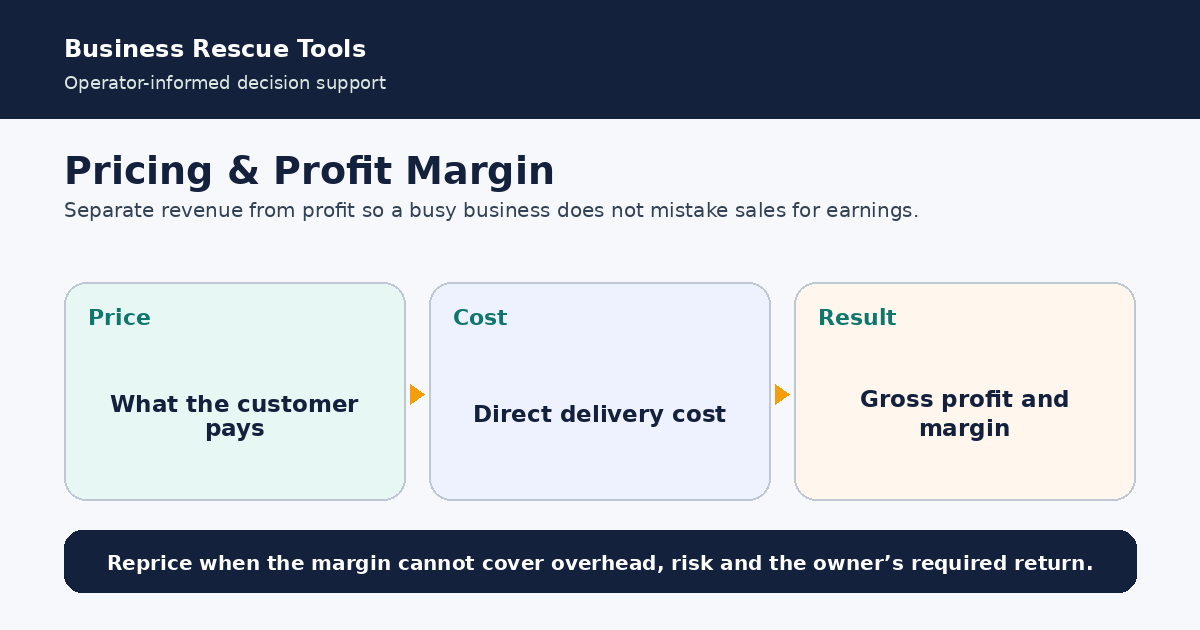
Running businesses with very different products—mobile-money services, floral work, entertainment and equipment—made one pricing problem obvious: owners often see the selling price but do not see every cost required to deliver the sale. A service can be popular, the calendar can be full and the cash can still fail to cover labor, transport, repairs, materials and overhead.
Markup and margin are not interchangeable
Adding a percentage to cost produces a markup; the profit as a percentage of selling price is the margin. Confusing the two can produce a lower margin than the owner intended. The Pricing and Profit-Margin Calculator displays both the gross profit amount and margin so the price decision is based on the same definition every time.
Direct cost must include the full delivery burden
For a floral order, direct cost may include flowers, wrapping, transport and labor. For equipment, it can include setup, delivery, cleaning and expected maintenance. For a transaction service, fees, staff time and reconciliation cost matter. Omitting one recurring cost makes a weak price look profitable.
A discount comes out of profit first
A ten-percent discount does not usually reduce profit by ten percent. When the original margin is narrow, the discount can remove a much larger share of profit and require many additional sales to recover the loss. The Discount Impact Calculator shows the volume increase required so an owner can test whether the promotional promise is realistic.
Break-even must respect capacity
The break-even formula is simple, but the decision is operational. If the business must sell more units than staff, equipment, inventory or demand can support, the price or cost structure must change. The calculator therefore belongs beside utilization and cash-flow decisions rather than being treated as an isolated accounting exercise.
How the field experience shaped the tools
The pricing calculators move from cost definition to minimum price, margin, discount pressure and break-even volume. They are designed to force the owner to enter the costs that are usually forgotten and to compare the required sales level with real capacity.
Include owner labor instead of treating it as free
Owner-led businesses often underprice because the owner performs planning, communication, purchasing, setup, delivery and follow-up without assigning a cost to that time. Even when the business does not pay a separate wage for each task, the price must eventually support the owner’s labor. Otherwise growth creates more work without creating enough cash to replace or compensate the person doing it.
Test the price against a realistic sales mix
Not every customer buys the highest-margin item. A useful pricing review considers the mix of products, discounts, delivery locations and payment methods that actually occur. One profitable item cannot automatically rescue several underpriced services. Owners should calculate margin by offer and then examine whether the expected mix can cover fixed costs and the minimum operating reserve.
Use the connected calculators
- Pricing and Profit-Margin Calculator
- Discount Impact Calculator
- Break-Even Calculator
- Minimum Profitable Price Calculator
McCauley, Jackie. “What Owner-Led Businesses Taught Me About Pricing, Margin and Discount Pressure.” Business Rescue Tools Operator Field Notes, August 5, 2026.