I operated Prime Money Services, including mobile-money services, an Ecobank Xpress Point and remittance support. That experience taught me that a counter can look busy, customers can be served, and the total money can still be wrong at closeout. The danger is not only theft. A shortage can come from a missed posting, a reversal recorded on one side, a fee treated incorrectly, a transfer assigned to the wrong provider, a customer obligation omitted from the ledger or a handover completed without independent evidence.
The total balance is not the control
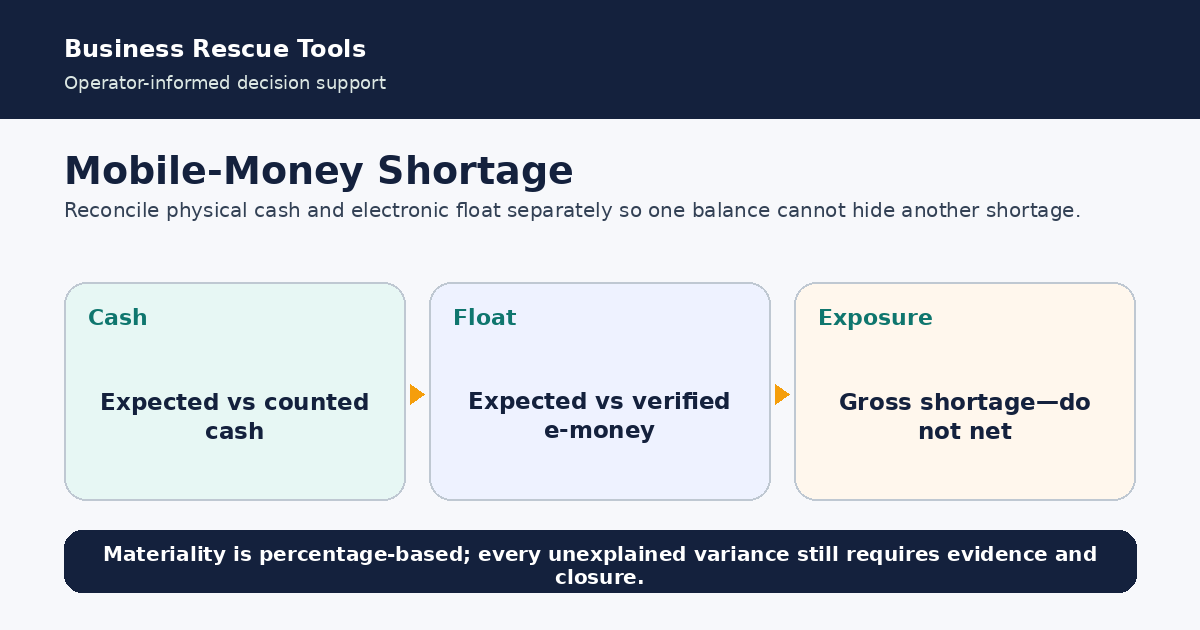
The most important lesson was that physical cash and electronic float must be reconciled separately. They move in opposite directions during common agent transactions. A cash surplus can appear beside a float shortage, or the reverse. Adding them together too early can produce a comforting net figure while one account remains materially wrong. The calculator therefore reports the cash variance, float variance and gross shortage exposure separately. It does not allow a surplus in one store of value to erase an unexplained shortage in another.
Remittance work raises the evidence standard
Remittance and Xpress Point transactions add another layer: timing, reference numbers, provider confirmations, reversals and customer proof may not all arrive in the same order. A staff member’s verbal explanation is not enough. The close should be supported by opening balances, provider statements, cash counts, transaction references, approved transfers, fees and documented corrections. When evidence arrives after close, the item should remain open as an exception rather than being forced into balance.
Materiality should follow the size of the operation
A fixed shortage amount is misleading across currencies and business sizes. One hundred units can be trivial in one currency and severe in another. That is why the revised tools compare unexplained exposure with expected closing value or transaction activity. A percentage threshold helps prioritize urgency, but it does not excuse smaller unexplained differences. Repeated small shortages can reveal a process problem long before one large loss appears.
Staff access needs a documented handover
When staff handle cash, float or transfers, the owner needs a clear opening assignment, transaction record, closing count and signed handover. The same person should not be able to transact, change the record and approve the correction without oversight. This is an operational control principle, not an accusation. A variance is evidence that the records do not yet explain the value; it is not proof of theft or legal liability.
How the field experience shaped the tools
The mobile-money calculators were designed around the sequence an operator actually needs: reconcile each store of value, measure the unexplained difference, compare it with activity, identify the account or staff exposure, preserve the first evidence and assign a dated resolution. The purpose is to make an exception visible early enough to investigate before the next shift or settlement makes the trail harder to reconstruct.
Use the connected calculators
- Mobile-Money Shortage Calculator
- Staff Cash Exposure Calculator
- Opening-to-Closing Variance Calculator
- Agent Float Sufficiency Calculator
McCauley, Jackie. “What Operating a Mobile-Money and Ecobank Xpress Point Business Taught Me About Daily Reconciliation.” Business Rescue Tools Operator Field Notes, August 5, 2026.