Calculate your result
Use figures from the same period and currency. Avoid mixing estimates with verified amounts without noting the difference.
Privacy: This calculation runs in your browser. The figures you enter are not submitted to our server.
Why this matters
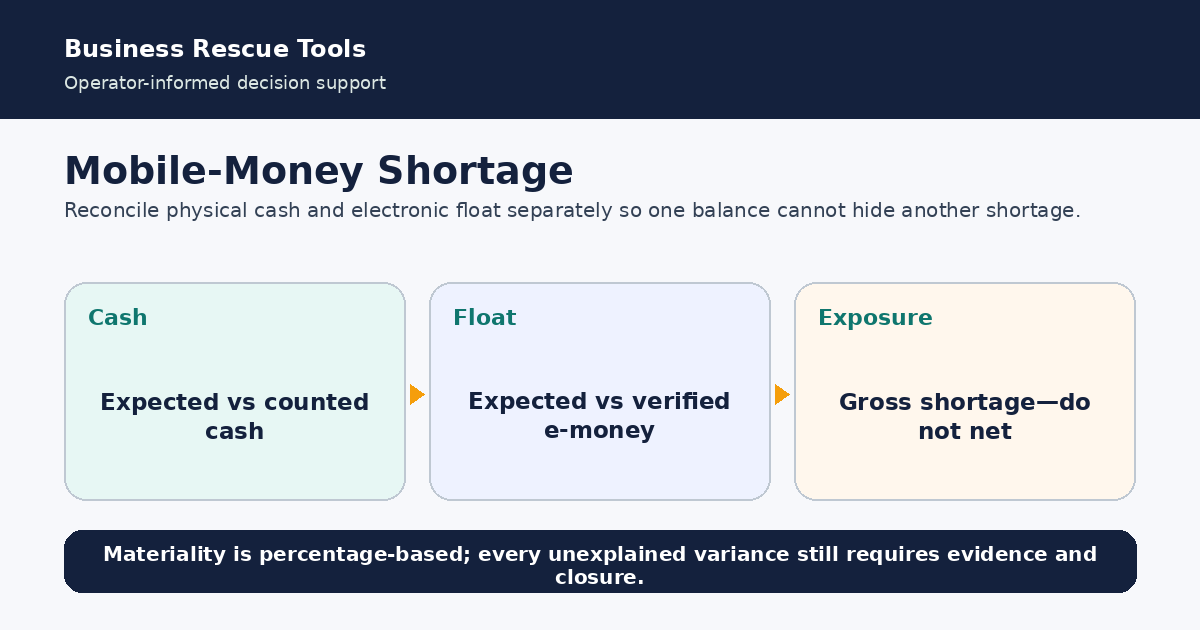
Mobile-money agents hold physical cash and electronic float that move in opposite directions. Netting them too early can hide a shortage in one account behind a surplus in another. The calculator supports the decision about the gross shortage exposure after cash and float are reconciled separately and compared with a percentage-based investigation threshold. Mobile-money operations can appear balanced in total while a specific cash, float, staff or transaction account remains exposed.
Use verified opening cash and float, transaction totals by direction, actual closing counts, provider statements, reversals and documented adjustments. Preserve the original evidence before adjustments, and keep physical cash, each provider wallet and other custodial balances separate. Mobile-money guidance is an internal-control diagnostic. It emphasizes separate custody accounts, independent evidence, percentage-based investigation thresholds and prompt exception handling. The investigation threshold is measured as a percentage of relevant value or activity so a currency denomination does not determine urgency. It is not formal accounting materiality.
How to act on the result
- Recount each store of value independently and preserve the first signed count
- Match shortages to transaction-level evidence, fees, reversals and transfers
- Restrict further access until unexplained material variances are assigned and resolved
Use the result as the start of an exception workflow: recount, reconcile, identify evidence, assign ownership, approve any correction independently and record closure. A surplus is also unresolved until supported; it may represent an omitted customer liability or posting error rather than business income.
Common mistakes and limits
Watch for using net combined variance as proof of balance, changing records to force a match, using an arbitrary currency amount for materiality and allowing the same person to transact and approve corrections. This tool does not prove theft, fraud or employee liability and does not replace provider statements, employment procedures, local regulation or a formal investigation. Repeated or material shortages require provider notification, formal investigation and legal or accounting advice consistent with local rules and employment procedures.
What this calculator answers
Which cash, provider, settlement, receivable or fee account contains a shortage, and how urgent is the investigation relative to expected balances or transaction activity?
Formula and assumptions
For each account: variance = verified closing balance − expected closing balance. Account shortage = max(0, expected − verified). Gross shortage exposure = the sum of account shortages. Gross surplus is shown separately and never offsets shortages. Investigation % = gross shortage ÷ the larger of total expected balances or entered transaction activity.
The result is an estimate. It is only as reliable as the inputs, and it does not account for every tax, legal, financing or operational consequence.
Worked example
Example: Physical cash is expected at $6,500 but verifies at $6,400, Orange Money is expected at $3,000 but verifies at $2,950, remittance settlement is expected at $1,000 but verifies at $900, and staff receivable is expected at $200 but verifies at $150. The tool reports $300 of gross shortage exposure. A surplus in Ecobank/Xpress Point or another account is displayed separately and does not erase those shortages. Against $20,000 of transaction activity, the shortage equals 1.50% of activity.
How to interpret the result
- Low: no immediate gap or the entered position is comparatively protected.
- Medium: manageable pressure exists, but it should receive a dated correction plan.
- High: the problem can materially damage cash or operations and requires near-term action.
- Critical: the entered assumptions indicate immediate loss, shortage or survival risk.
Authoritative references
These references explain relevant accounting, cash-flow, legal or control concepts. Business Rescue Tools remains responsible for the calculator formula, assumptions and editorial thresholds.
Frequently asked questions
Why are cash and float shortages not netted against surpluses?
A surplus in one account does not explain missing value in another. Each account must be reconciled independently before any transfer or posting explanation is accepted.
What is the investigation threshold?
It is the percentage of expected balances or transaction activity that triggers stronger investigation. Set it according to the business’s risk tolerance and provider requirements.
Should a variance below the threshold be ignored?
No. The threshold prioritizes urgency. Every unexplained variance should still be documented, investigated and resolved.
What if expected closing cash or float becomes negative?
That usually indicates inconsistent signs, missing funding, an omitted transfer or outflows that exceed available value. The form blocks calculation until the records are corrected.